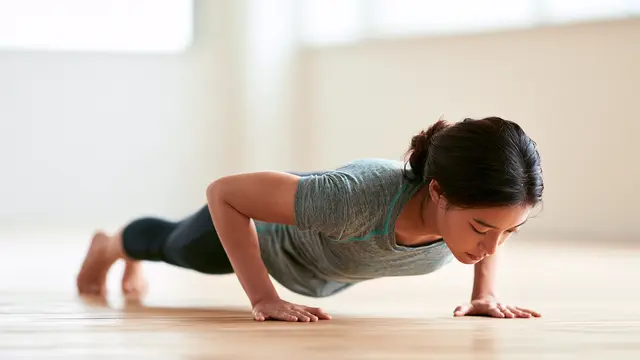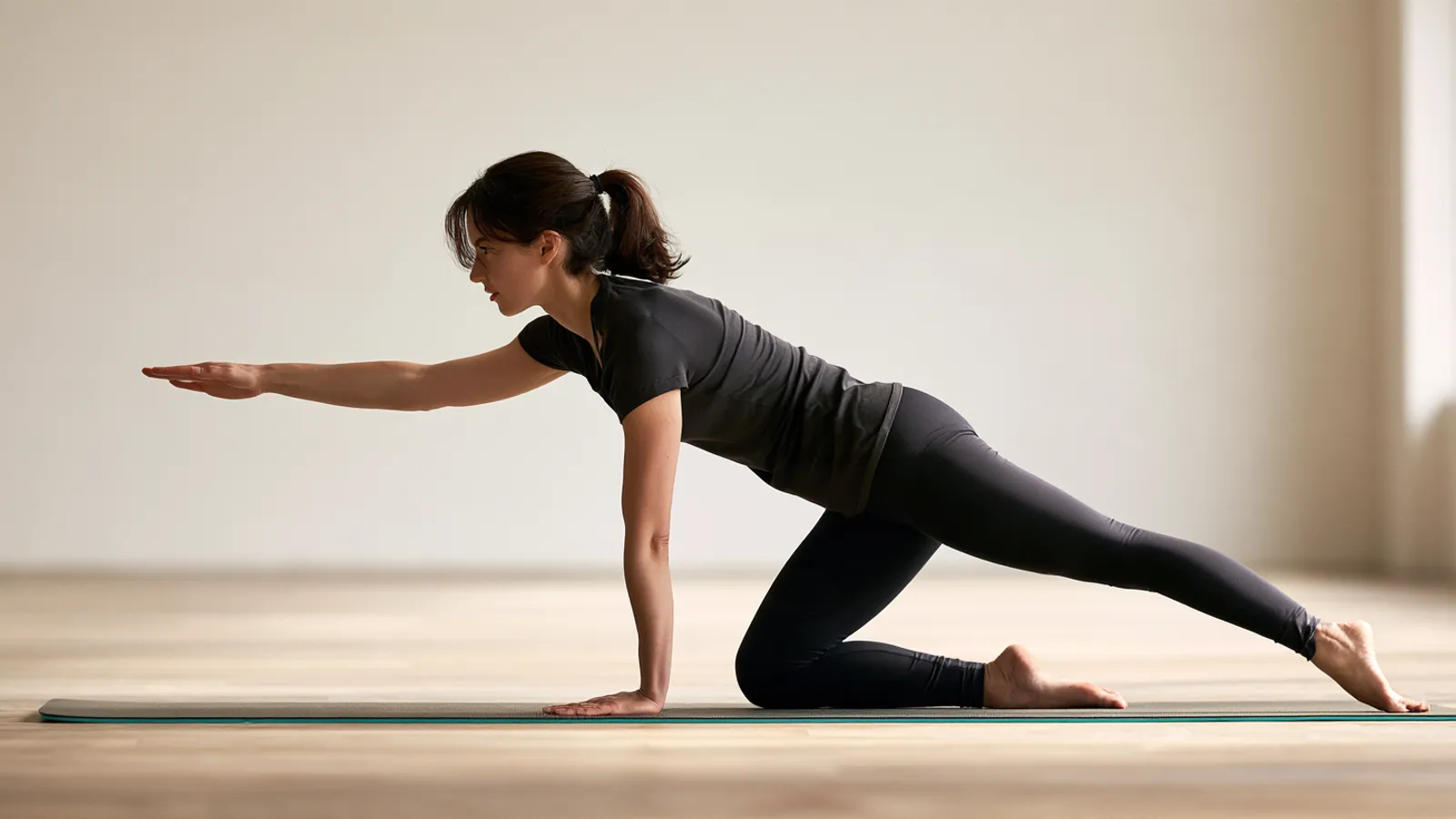
Pilates is hugely popular, from reformer classes to short routines on a phone app. It also has a reputation for doing a bit of everything: a stronger core, better posture, a healthier back, a "toned" look. Strength training promises many of the same things, with dumbbells and barbells instead of a mat.
So which should you choose? The research gives a fairly clear answer: they're good at different things, and most people do best with both. Here's what each one does well, and a simple way to combine them.
What Pilates is
Pilates is a system of controlled exercises developed by Joseph Pilates in the early 20th century. A systematic review of 119 research papers found broad agreement on what it involves: a mind-body exercise that focuses on strength, core stability, flexibility, muscle control, posture and breathing, done on a mat or with specialised equipment.1 The best-known machine is the reformer, a sliding carriage with springs that add resistance or assistance.
What about "Asian Pilates"?
"Asian Pilates" is a name used by several fitness apps and social media programs, mostly for short, low-impact routines you do on a mat at home. The routines vary from one program to the next, and there's no published research on Asian Pilates as a method of its own. The fairest way to judge it is like any other mat Pilates: by how much it challenges you and how regularly you do it.
What Pilates does well
Core endurance and flexibility
In a randomised trial, 50 active middle-aged men and women were assigned either to a one-hour mat Pilates class twice a week for 12 weeks or to a control group. The Pilates group significantly improved their abdominal endurance, hamstring flexibility and upper-body muscular endurance. Their posture and balance, however, didn't improve compared with the control group.2 Better posture is a possible bonus, not a guarantee.
Balance, strength and falls in older adults
For people over 60, the evidence is stronger. A meta-analysis of 39 randomised trials found that Pilates improved balance, strength, flexibility and everyday physical function compared with no exercise or usual activity, and had a large effect on reducing the risk of falls. The certainty of the evidence was moderate for strength and falls, and low for the other outcomes.3
Does Pilates build muscle?
Some, especially in your abs. In a small study, nine previously inactive women did Pilates twice a week for nine months. MRI scans showed that the volume of their rectus abdominis (the "six-pack" muscle) increased by 21%.4 The study had no control group, but it shows that Pilates can make a muscle grow when it challenges it enough.
The limit is load. Pilates mostly uses your body weight, springs and light bands. That's plenty for your abs, but it's hard to keep adding resistance for big muscles such as your glutes, thighs and back. Steadily adding weight over time is exactly what strength training is built around.
Pilates vs strength training, head to head
Few studies compare the two directly. In one randomised trial, women aged 60 to 80 did either Pilates (mostly mat work, with bands added later) or a resistance program (chair stands, squats, lunges, dumbbells and bands) twice a week for 18 weeks, at similar levels of effort. Both groups got stronger at extending their trunk and hips, and both got quicker at a get-up-and-walk test. Only the Pilates group beat the control group on static (isometric) hip-extension strength, while only the resistance group improved in every measure of hip strength through movement.5
The trial was small (49 women finished it), but the pattern makes sense: both work, and each is best at the kind of strength it trains.
Back pain: both help
Back pain is one of the main reasons people try Pilates, and the evidence supports it. A network meta-analysis of 118 trials with 9,710 adults with chronic low back pain found that almost every type of exercise reduced pain and disability compared with control groups. Pilates ranked highest for both, and strength and core exercises were also in the top three for reducing disability. The authors concluded that the most helpful programs included at least one or two sessions a week of Pilates or strength exercises.6
So if Pilates helps your back and you enjoy it, there's good reason to keep going. If you'd rather lift, that's a solid option too. If you have back pain, a doctor or physiotherapist can help you choose a safe place to start.
Bone health: where strength training does more
When researchers pooled 11 studies of Pilates or yoga in women aged 45 to 78, they found no significant effect on bone mineral density compared with control groups. The authors noted that simply holding on to bone density after menopause, when it usually falls, could still count as a benefit.7
Bone responds best to high loads applied quickly, and strength training can provide them. In the LIFTMOR trial, 101 postmenopausal women with low bone mass did either 30 minutes of supervised heavy resistance and impact training twice a week (5 sets of 5 reps at more than 85% of their maximum) or a low-intensity home program, for 8 months. In the heavy-training group, bone density rose by about 3% at the spine and held steady at the hip, while the home group lost bone at both sites. Only one minor problem was reported: a lower back spasm.8
That training was closely supervised. If you have osteoporosis or low bone density, get medical advice and qualified coaching before you lift heavy.
Is Pilates enough exercise?
The World Health Organization recommends that adults get 150 to 300 minutes of moderate aerobic activity a week (or 75 to 150 minutes of vigorous activity), plus muscle-strengthening activities at moderate or greater intensity that work all major muscle groups on 2 or more days a week. For adults 65 and over, it adds varied activity that emphasises balance and strength training on 3 or more days a week, to improve everyday function and prevent falls.9
Measured against that, Pilates covers part of the picture. A challenging session can count as muscle strengthening, and for older adults it fits the balance-and-strength recommendation well. But the mat routine in the 12-week trial above was described as relatively low-intensity,2 so Pilates usually won't replace walking, cycling or other aerobic exercise. And it doesn't load your legs, back and bones the way lifting can.
How to combine them
You don't have to pick a side. Start with whichever you enjoy most, then add the other:
- If Pilates is your main exercise: keep your 2–3 sessions a week and add 2 short full-body strength sessions built on a squat, a hip hinge (such as a deadlift), a push and a pull. Add weight gradually as you get stronger.
- If you mainly lift: add one Pilates session a week, or a 10-minute core routine at the end of two workouts. The dead bug, Pallof press and single-leg glute bridge train similar trunk and hip control, and the core-stability guide shows how to progress them.
- Either way: walk, cycle or swim to reach the weekly aerobic minutes. See how many steps a day you really need.
A sample week with both:
- Monday: strength
- Tuesday: Pilates
- Wednesday: strength
- Thursday: brisk walk, 30–45 minutes
- Friday: strength
- Saturday: Pilates
- Sunday: rest or an easy walk
Because most Pilates is lower in intensity, it fits well on the days between strength sessions.
How to start this week
- Pick your base: whichever one you'll actually keep doing.
- Add one session of the other each week. That's enough to begin.
- Track your progress. In Pilates, note which harder versions you can now do with control. In the gym, write down your weights and reps, and add a little when the top of your rep range feels easy.
- Follow a plan. The 3-Day Full Body program trains every major muscle group with squats, deadlifts, presses and rows in three sessions a week, and leaves the other days free for Pilates. Follow it in the TrainSmart app, with an animated demo for every exercise.
Pilates and strength training aren't rivals. One builds control, endurance and flexibility; the other builds strength, muscle and bone by steadily adding load. Add some walking, and together they cover everything the guidelines ask for.