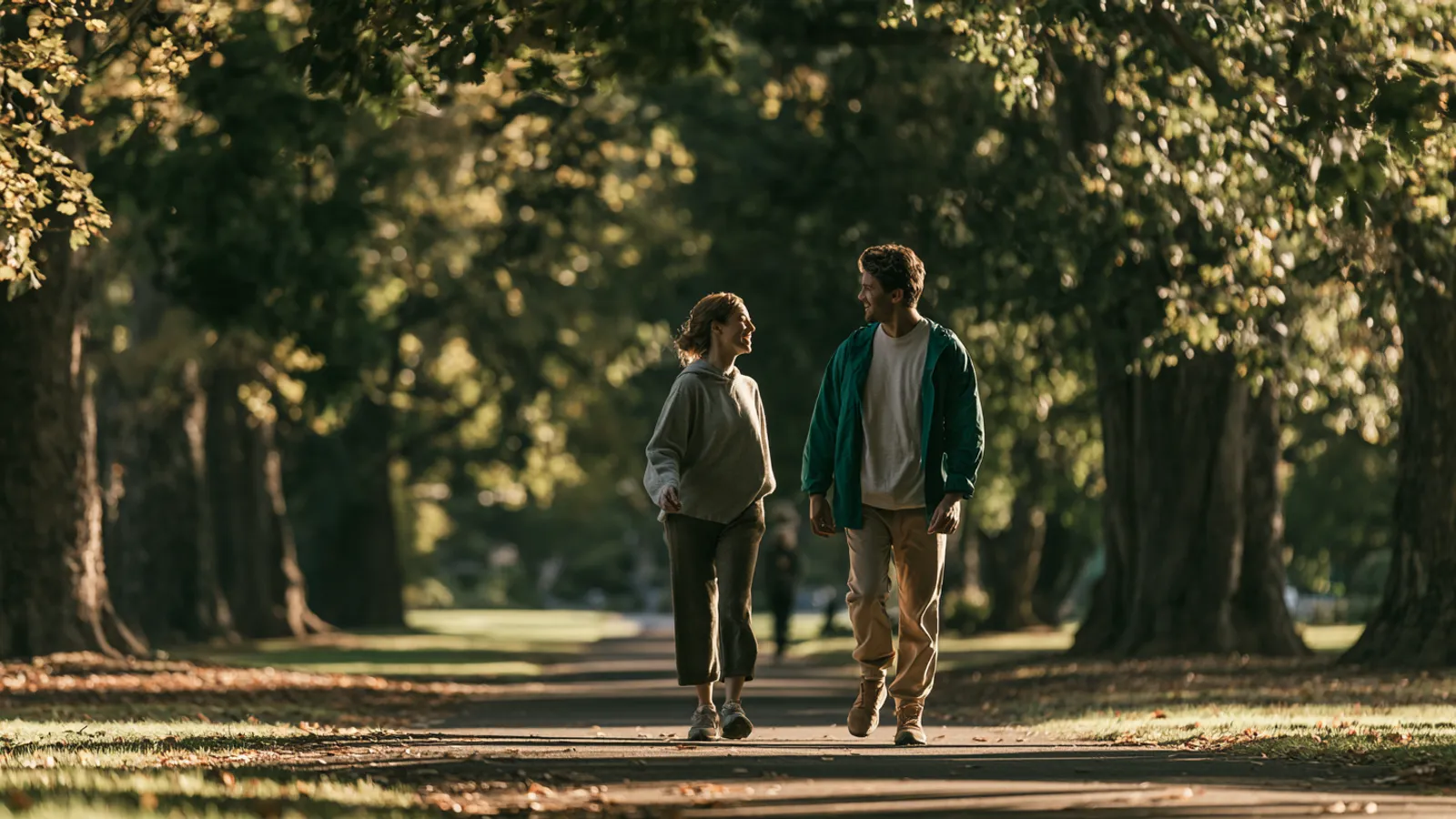
Ten thousand steps a day is probably the best-known fitness target in the world. It's built into phones and watches, and every few months social media adds a new twist: 8,000 steps, "Japanese walking," "tai chi walking." So how many steps do you actually need, and does the way you walk matter?
Here's what the largest studies say, and how to turn it into a daily habit.
Is 10,000 steps backed by science?
Not as a magic threshold. A 2022 meta-analysis of 15 international studies with more than 47,000 adults began by noting that 10,000 steps a day is widely promoted, but there's little evidence behind that specific number.1
What the researchers found was a sliding scale. The more steps people took, the lower their risk of dying during the study, but the benefit levelled off. For adults aged 60 and over, the curve flattened at around 6,000–8,000 steps a day. For adults under 60, it flattened at around 8,000–10,000.1
A larger 2025 review of 57 studies looked beyond mortality at heart disease, cancer, diabetes, dementia, depression and falls. Compared with 2,000 steps a day, 7,000 steps was linked to:2
- a 47% lower risk of death from any cause
- a 25% lower risk of developing cardiovascular disease
- a 38% lower risk of dementia
- a 22% lower risk of depressive symptoms
For several outcomes, most of the benefit had arrived by around 5,000–7,000 steps. The authors concluded that 10,000 steps is still a fine goal if you're already active, but 7,000 a day is linked to meaningful health benefits and may be a more realistic target for many people.2
The gains start well below either number. In a study of older women, those averaging about 4,400 steps a day had lower death rates than those averaging about 2,700, and the benefit kept growing until about 7,500 steps.3
One caveat applies to all of this: these are observational studies. They show that people who walk more tend to be healthier. They can't fully rule out other explanations, but the pattern holds across studies from many countries.
So what's a good daily target?
Based on that research, a sensible approach looks like this:
- Under about 4,000 steps a day? Don't aim for 10,000 overnight. Add 1,000–2,000 steps a day and build up gradually. Even this range was linked to benefits.3
- Around 5,000–7,000? Push toward 7,000–8,000. That's where much of the benefit showed up in the 2025 review.2
- Under 60 and already at 8,000? Going up to around 10,000 may still add a little, based on the 2022 analysis.1
The "8,000 steps a day" trend fits the evidence well. It's realistic for most people and sits right inside the range where the benefits were seen.
Does walking pace matter?
For overall health guidelines, yes. The CDC recommends at least 150 minutes a week of moderate-intensity activity, such as brisk walking, plus muscle-strengthening activity on 2 or more days.4 The NHS describes a brisk walk as about 3 miles (roughly 5 km) an hour: you can still talk, but you can't sing.5 Even a brisk 10-minute daily walk counts toward the 150 minutes.5
For step counts specifically, the picture is mixed. In the older women's study, faster stepping wasn't clearly linked to lower mortality once total steps were taken into account.3 In the 2022 meta-analysis, people with a faster "best 30 minutes" of walking still had lower risk after adjusting for total steps.1 A practical takeaway: get your daily steps first, and make some of them brisk.
Trend check: Japanese interval walking
"Japanese walking" is based on interval walking training studied by researchers in Japan. In one of their trials, participants, with an average age of 63, alternated 3 minutes of fast walking with 3 minutes of easy walking, at least 5 times per session, on 4 or more days a week, for 5 months.6
Compared with a group that walked continuously at a moderate pace (aiming for 8,000+ steps a day), the interval walkers improved thigh strength by 13–17% and aerobic fitness by 8–9%. They also saw a larger drop in resting blood pressure.6 Not everyone stuck to the plan, and the participants were middle-aged and older, but it's a simple way to get more out of the walks you already do.
To try it: walk easily for 3 minutes, then fast enough that you can only speak in short phrases for 3 minutes. Repeat 5 times, for 30 minutes in total.
Trend check: tai chi walking
"Tai chi walking" videos show slow, deliberate steps with flowing arm movements. We couldn't find any trials testing the health effects of these routines themselves. Tai chi itself is a practice of slow, gentle movements with controlled breathing, and research suggests it may improve balance and help prevent falls in older adults.7
So tai chi walking can be a calming warm-up or a balance practice. But slow walking isn't moderate-intensity activity, so it won't replace brisk walking toward the 150-minute guideline.4
Easy ways to add steps
The NHS suggests building walking into your routine rather than relying on willpower:5
- Walk part of your journey to work.
- Take the stairs instead of the lift.
- Walk to the shops, or leave the car behind for short trips.
- Make a regular walk with a friend part of your week.
- Take a stroll with family or friends after dinner.
Taking phone calls on the move is another easy win. On rainy or dark evenings, a treadmill counts too. Raising the incline makes a walk harder without making it faster. See the treadmill walking demo.
Walking is the base, not the whole plan
Walking covers the aerobic part of the guidelines, but adults also need muscle-strengthening activity on at least 2 days a week.4 A good weekly structure is a daily step target plus two or three short strength sessions.
How to start this week
- Find your baseline. Check your phone's or watch's average daily steps for the last 7 days.
- Add about 1,000 steps a day. That's roughly a 10-minute walk for most people. Hold that for a week, then add another 1,000 until you're at 7,000–8,000.
- Make two walks interval walks. Try the 3-minute fast, 3-minute easy pattern above.
- Add strength twice a week. The 3-Day Full Body program fits around a walking habit. If you prefer more structure, the 5-Day Transformation builds Stretch & Cardio days into the week, which are perfect for a long walk. Follow either in the TrainSmart app.
You don't need 10,000 steps to start benefiting. If you're starting from a low baseline, every extra 1,000 steps moves you in the right direction.