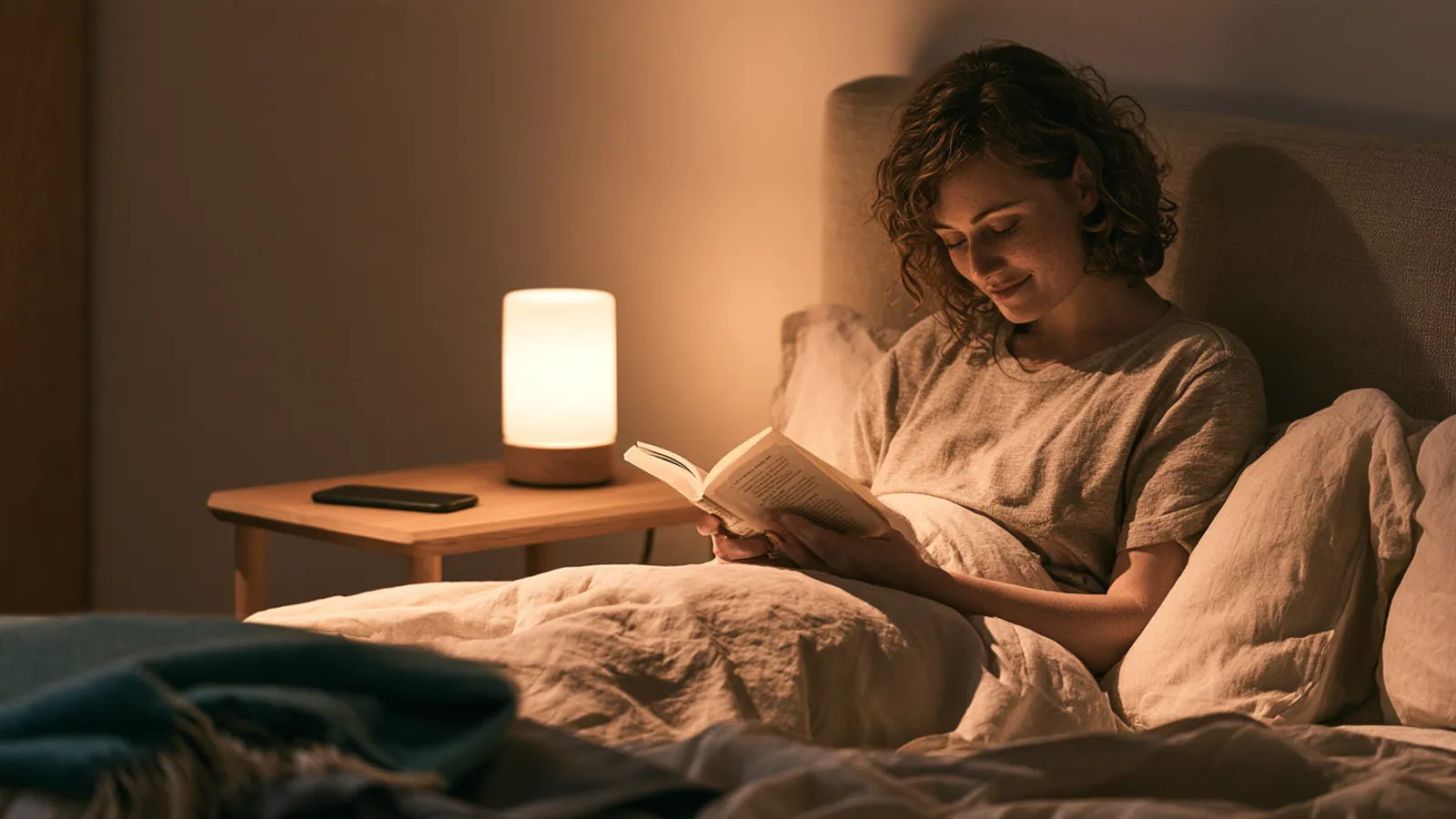
Lying awake while the minutes tick by is frustrating, and trying harder to sleep rarely helps. You can't force sleep, but you can set up the conditions that let it come more easily: a steady body clock, a calm last hour before bed, and a plan for the nights when your mind won't switch off.
Here's what the evidence supports, what to do tonight if you can't sleep, and when to see a doctor.
Start with a fixed wake-up time
The most useful habit is the least exciting one. Going to bed and getting up at similar times each day helps your body learn when it's time to sleep, and the NHS suggests keeping the same routine on days off.1
Anchor your schedule to your wake-up time, the part you can control. A joint statement from the American Academy of Sleep Medicine and the Sleep Research Society says adults should sleep 7 or more hours a night on a regular basis.2 So if you get up at 6:30, aim to be in bed by about 11 pm.
Three rules help:
- Keep weekends within about an hour. The US National Heart, Lung, and Blood Institute (NHLBI) warns that staying up late and sleeping in at weekends can disrupt your body clock.3
- Don't sleep in after a bad night. The NHS advises sticking to your regular hours instead.4
- Go to bed when you feel sleepy, not earlier to "catch up."4
Use light on your side
Light is a strong signal for your body clock. In experiments, artificial light in the evening makes people more alert, suppresses the sleep hormone melatonin and shifts the body clock later.5
During the day, get outside: the NHLBI recommends spending time outside every day.3
In the evening, do the opposite. In a sleep-lab study, 12 young adults read for about 4 hours before bed on five evenings, either on a light-emitting e-reader or from a printed book. After the e-reader, they took nearly 10 minutes longer to fall asleep, felt less sleepy at bedtime, produced less melatonin and were less alert the next morning.5 It was a small study with long reading sessions, so it can't say how much a quick scroll matters, but it's a good reason to follow the NHS advice: put phones, tablets and computers away for an hour before bed.1
Make the bedroom quiet, dark and cool.1 Curtains or blinds, an eye mask or earplugs can help.4
Time your caffeine, alcohol and dinner
- Caffeine: its effects can last up to 8 hours, so a cup of coffee in the late afternoon can make it hard to fall asleep.3 Caffeine is also in tea, cola and chocolate,3 so check the label on energy drinks and pre-workout products too.
- Alcohol and nicotine: both can disrupt sleep.1 The NHS advice for insomnia is no smoking, alcohol, tea or coffee for at least 6 hours before bed.4
- Dinner: avoid a big meal late at night.4 If you want a warm drink in the evening, try a milky drink or herbal tea.1
Exercise helps, and evening workouts are usually fine
Regular physical activity can help you sleep better, and even small amounts count.1
Many people skip evening workouts for fear of poor sleep. A 2019 meta-analysis of 23 studies in healthy adults didn't support that fear. If anything, sleep after an evening session was slightly deeper. The exception was vigorous exercise that ended within about an hour of bedtime, which might make it harder to fall asleep and shorten sleep.6
So train when it fits your day, but try to finish hard sessions at least an hour before bed. If you notice that late workouts keep you awake, move them earlier.1 If you have insomnia, the NHS is more cautious: no exercise in the 4 hours before bed.4
Give yourself a wind-down hour
The NHS recommends relaxing for at least an hour before bed, for example with a bath or a book.4 Other calming options include reading something you enjoy, meditation, breathing exercises and calming music or a podcast.1
A few minutes of gentle stretching can be part of it. Try child's pose and the cat stretch with slow breathing, or an easy-paced version of our hip, hamstring and lower back routine. This is about relaxing, not training.
Viral tricks like the "military method" or 4-7-8 breathing are variations on the same idea: slow breathing and a relaxed body. They're fine to try, but don't expect an off switch.
If your mind is racing, write a to-do list
Worrying about unfinished tasks is a common reason for lying awake.7 In one sleep-lab study, 57 healthy young adults spent 5 minutes writing before lights out. Those who wrote a to-do list for the next few days fell asleep about 9 minutes faster than those who wrote about tasks they had already finished (about 16 versus 25 minutes). The more specific the list, the faster they fell asleep.7
That was one night in young adults without sleep problems, so treat it as a promising, low-effort trick rather than a cure. The NHS gives similar advice: if you often worry in bed, make a list of things you need to do the next day before you go to sleep.1 Use paper rather than your phone.
Can't sleep? Get up after about 20 minutes
The NHS advice is not to force it. If you're still awake after around 20 minutes, get up, sit somewhere comfortable and do something relaxing, like gentle yoga, reading or listening to quiet music. Go back to bed when you feel sleepy.1
Keep the lights low, stay off your phone and don't watch the clock: a rough sense of 20 minutes is enough. Then get up at your usual time the next morning, even after a bad night.4
Don't chase a perfect sleep score
Sleep trackers aren't sleep labs. A 2021 study tested 7 consumer sleep trackers against lab sleep recordings (polysomnography) in 34 healthy young adults. The devices were good at detecting sleep, but much weaker at detecting time spent awake. Their sleep-stage estimates were inconsistent, and they tended to perform worse on nights of disrupted sleep.8
So use your tracker for trends over weeks, not one night's score. How you feel during the day is a better guide, and if checking the score makes you anxious, put it away.
Naps: keep them short and early
If you have trouble falling asleep at night, the NHLBI advises limiting naps or taking them earlier in the afternoon,3 and the NHS advice for insomnia is not to nap during the day at all.4 For more, see our guide to how long to nap.
When to see a doctor
These habits help with everyday sleeplessness, but they don't treat a sleep disorder. The NHS advises seeing a GP if:4
- changing your sleep habits hasn't helped
- you've had trouble sleeping for months
- poor sleep is affecting your daily life in a way that makes it hard to cope
Insomnia that lasts 3 months or longer is called long-term insomnia. A doctor may offer cognitive behavioural therapy (CBT), face to face or through an online programme, to help change the thoughts and behaviours that keep you from sleeping. Sleep aids sold in pharmacies can't cure insomnia, so check with your doctor before taking anything for sleep problems.4 That includes supplements such as melatonin.
Also see a doctor if you always feel very tired during the day, or if someone notices that you snore loudly, stop breathing or make gasping, snorting or choking noises in your sleep. These can be signs of sleep apnoea.9 And don't drive when you feel sleepy.4
Your plan for tonight
- Pick a wake-up time you can keep every day this week, and count back at least 7 hours of sleep to set your bedtime.
- Set a caffeine cut-off about 8 hours before bed.
- Make the last hour calm: lights down, phone away, a 5-minute to-do list on paper and a few gentle stretches.
- If you're still awake after about 20 minutes, get up and do something calm until you feel sleepy.
- Move during the day. The 3-Day Full Body program gives you three sessions a week with rest days in between. Follow it in the TrainSmart app, and schedule sessions earlier if late workouts keep you up.
Give a new routine a couple of weeks. If your sleep doesn't improve, that's a reason to talk to a doctor, not to try harder.