You don't need a gym, dumbbells or a lot of time to build strength. Your body weight, a bit of floor space and about 20 minutes are enough to train every major muscle group, and to meet the strength part of the international activity guidelines.
This guide gives you a complete no-equipment workout, easier and harder versions of every move, and a simple way to keep progressing so it doesn't get stale after two weeks.
Why strength training at home is worth it
The World Health Organization estimates that nearly a third of adults worldwide don't get enough physical activity. It stresses two points that make home training a good place to start: any amount of activity is better than none, and muscle strengthening benefits everyone.1
The CDC recommends muscle-strengthening activity on at least 2 days a week, working all the major muscle groups: legs, hips, back, abdomen, chest, shoulders and arms. That's on top of 150 minutes of moderate aerobic activity, such as brisk walking.2 The NHS lists exercises that use your own body weight, like push-ups and sit-ups, among the activities that count.3
You don't need hours, either. A large review of cohort studies found that muscle-strengthening activity was linked to a 10–17% lower risk of early death from any cause, and of cardiovascular disease, cancer and diabetes. For early death, cardiovascular disease and cancer, the biggest reduction showed up at around 30–60 minutes a week.4 These studies show an association, not proof of cause and effect, but two or three 20-minute sessions land right in that range.
Can bodyweight exercise really build muscle?
Yes, as long as the sets are hard enough. In a review of 21 studies where every set was taken to muscular failure, lighter loads built as much muscle as heavy ones. Heavy loads were still better for maximum strength.5 In another trial, trained young adults doing push-ups made harder with an elastic band gained as much strength over five weeks as a group doing the bench press at a similar effort level.6
The key is effort, not equipment. The NHS puts it simply: do strength exercises to the point where you need a short rest before repeating them.3 In practice, end each set when your form starts to slip or you feel you have only one or two good reps left.
The 20-minute no-equipment workout
Warm-up (3–4 minutes): march on the spot, do arm circles, then 10 slow half-depth squats and 10 hip hinges (push your hips back with a flat back, then stand tall).
The circuit: do the six moves back to back, rest 60–90 seconds, then repeat for 3 rounds in total. Beginners can start with 2 rounds.
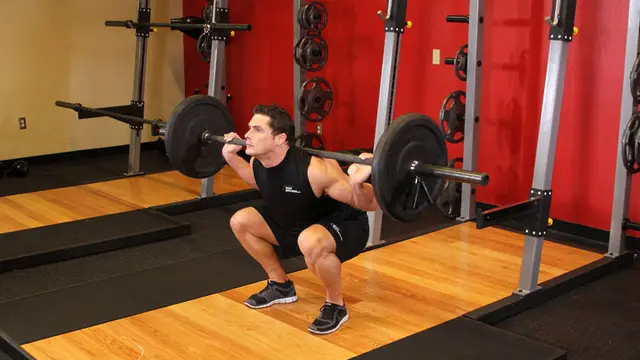
1. Squat (legs and hips), 10–20 reps
Feet about shoulder-width apart, sit your hips back and down as far as you can with your heels on the floor, then stand up. Check your form with the animated bodyweight squat.
- Easier: sit-to-stand from a sturdy chair, the way the NHS home strength routine does it.7
- Harder: take 3 seconds to lower yourself, pause at the bottom, or try split squats with your back foot on a sofa.
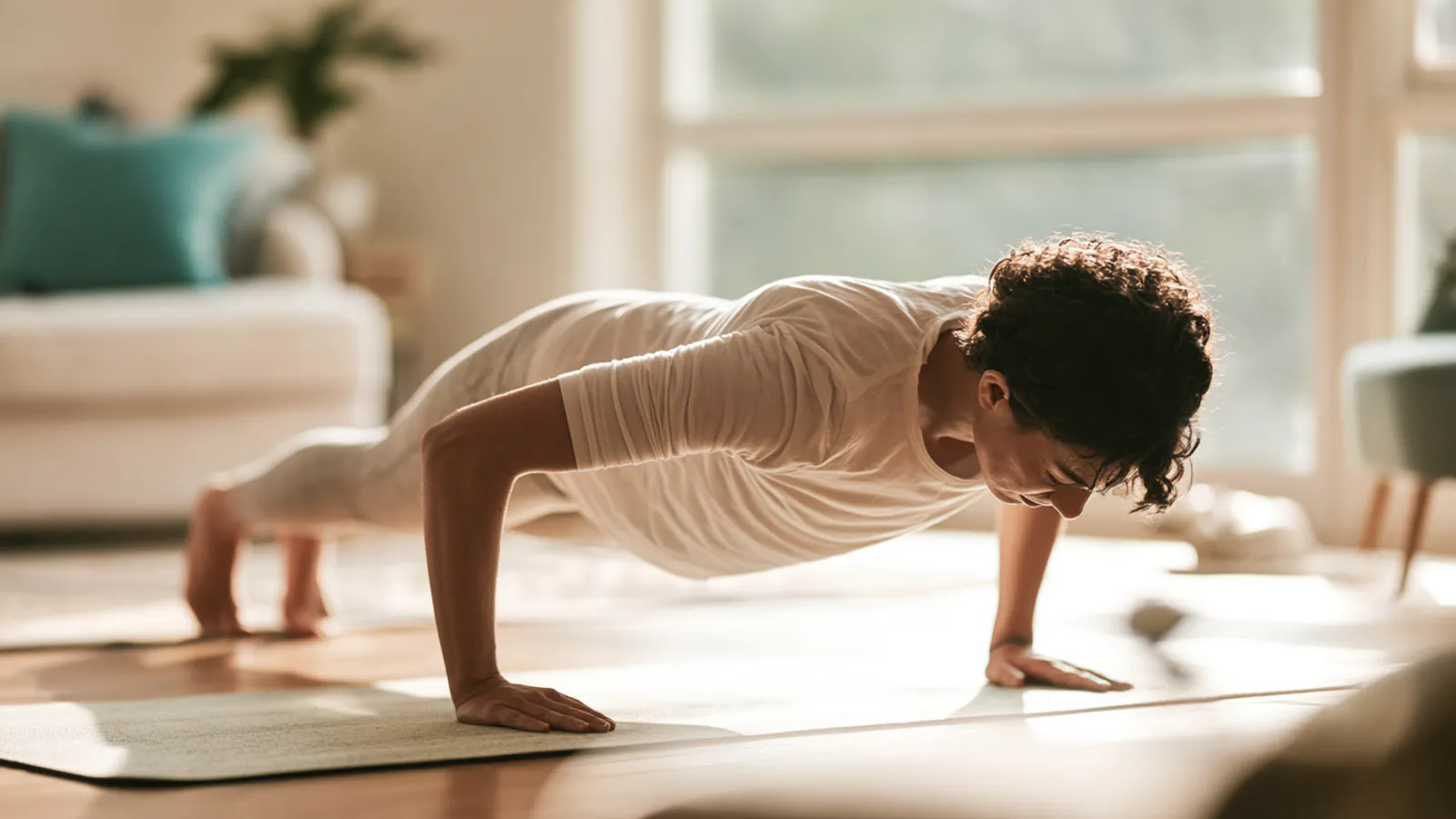
2. Push-up (chest, shoulders, arms), 5–15 reps
Hands slightly wider than your shoulders, body in one straight line from head to heels. Lower your chest almost to the floor, then press back up. Watch the push-up demo.
- Easier: start with wall press-ups, as in the NHS home routine,7 then put your hands on a kitchen counter or a sturdy table. The higher your hands, the easier it gets.
- Harder: slow the lowering to 3 seconds, or raise your feet on a step.
3. Reverse lunge (legs and glutes), 8–12 reps per leg
Step one foot back, lower your back knee toward the floor, then push through your front foot to return. Hold a chair for balance if you need to.
4. Glute bridge (glutes and hamstrings), 12–20 reps
Lie on your back with knees bent and feet flat. Push through your heels to lift your hips until your body forms a straight line from shoulders to knees, and pause for a second at the top. To make it harder, do it on one leg.
5. Superman (upper and lower back), 8–12 reps
Lie face down with your arms overhead. Lift your arms, chest and legs a few centimetres off the floor, hold for 2 seconds and lower slowly. Back muscles are the hardest to train without equipment because there's nothing to pull against, so don't skip this one.
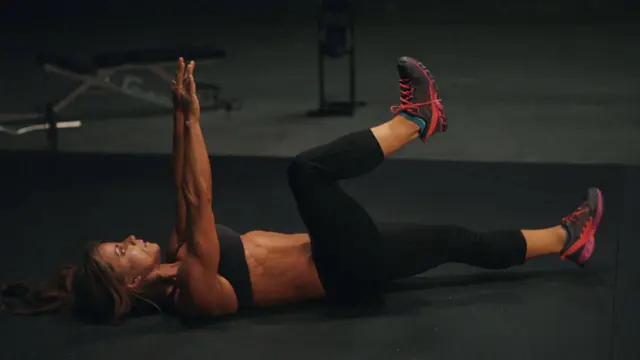
6. Dead bug (core), 6–10 reps per side
Lie on your back with arms pointing to the ceiling and knees bent at 90 degrees over your hips. Press your lower back gently into the floor, then slowly lower the opposite arm and leg and bring them back. Keep your lower back down the whole time. See the dead bug demo.
Each round takes about 5 minutes, so three rounds plus the warm-up comes to roughly 20 minutes.
How to keep progressing
Your body adapts, so the workout has to get gradually harder. The NHS advice for home strength routines is to build up slowly and increase repetitions over time.7 Change one thing at a time:
- Add reps until you reach the top of each range.
- Slow down. A 3-second lowering phase makes any move harder with no extra equipment.
- Switch to a harder version once you can do about 20 clean reps (for example, incline push-up to floor push-up, or bridge to single-leg bridge).
- Add a round or shorten your rest.
Do the workout 2–3 times a week on non-consecutive days, for example Monday, Wednesday and Friday. That covers the guideline of strength training on at least 2 days.2
A few safety notes
- If you haven't exercised for a while, or you have a medical condition, the NHS advises speaking to your GP first.3
- Use a mat or carpet, clear the space around you, and wear shoes with grip, or go barefoot on a non-slip floor.
- Muscle soreness a day or two later is normal when you start. Sharp or joint pain is not: stop that exercise and switch to the easier version.
How to start this week
- Schedule two sessions in your calendar now, two or three days apart.
- Session 1: do 2 rounds and write down your reps for each move.
- Session 2: do 3 rounds and try to beat at least one number from session 1.
- Plan your next step. When bodyweight moves start to feel easy, add external load. The 3-Day Full Body program trains the same squat, push, pull, hinge and core patterns with weights, and you can follow it day by day in the TrainSmart app with an animated demo for every exercise.
Twenty minutes, twice a week, is a habit you can keep, and it's enough to start feeling stronger within a few weeks.